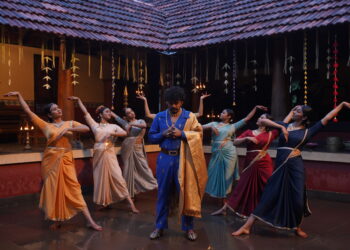


Anyone familiar with the works of Krishand would know that he is an unusually bold filmmaker whose style is instantly recognizable. His films stand miles apart from conventional cinema. They often feel like cinematic graffiti: absurd, rebellious, striking, and certainly not designed to please everyone.
With his latest film, Masthishka Maranam: A Frankenbiting of Simon’s Memories, Krishand ventures into dystopian futuristic dark comedy, presenting a concept that is as ambitious as it is eccentric. Even the title itself hints at the unusual experience the film promises.

The narrative world of the film is packed with imaginative elements: flying cars, memory editing technology, cyborgs, massive VR systems capable of streaming human memories as immersive experiences, AI humanoids capable of sharp-witted banter, and even a mutated JARVIS-like system that produces striking custom soundtracks. Considering the film’s limited budget, the scale of the visual spectacle achieved by the team is genuinely impressive.
One of the film’s biggest highlights is the performance of Rajisha Vijayan as Frida Soman. Known already for her strong performances, Rajisha elevates the role into something far more explosive within Krishand’s chaotic cinematic universe. Frida Soman emerges as a fierce anti-heroine who dominates the narrative with unpredictable energy, frequently overshadowing the male lead.
That male lead, Bimal, portrayed by Niranj Maniyanpilla Raju, delivers a convincing performance as a grieving father struggling with alcoholism and addiction to virtual reality. While his portrayal is compelling, the character often becomes somewhat secondary amid Frida’s intensity and the overwhelming number of narrative elements surrounding him, which appears to be a deliberate creative choice.
The film also features a large ensemble cast, including several familiar collaborators from Krishand’s previous works such as Sanju Sivaram, Vishnu Agasthya, and Sachin Joseph. Veteran actors such as Jagadish, Nandhu, and Suresh Krishna also appear in significant roles, alongside performers like Santhy Balachandran, Divya Prabha, Zhins Shan, and Rahul Rajagopal.
Among these performances, Jagadish stands out as a futuristic police inspector whose humor feels almost tailor-made for the actor. Vishnu Agasthya delivers a stylish and entertaining performance as the ruthless Advocate Don, combining comic timing with a strong screen presence. Meanwhile, Suresh Krishna appears as Charles, also known as Dinkappan, a comically inappropriate karate master whose character provides several humorous moments. It is refreshing to see him explore roles different from the villainous archetypes that defined much of his earlier career.
Beyond the cast, the true strength of the film lies in its crew. The film is edited by Krishand himself, employing rapid cuts that maintain relentless momentum and rarely allow the viewer a moment of disengagement. The background score and songs composed by Varkey are distinctive and energetic, adding further intensity to the film’s tone.
The production design also deserves special mention. Krishand, along with Alvin Joseph, crafts the film’s visual world with remarkable creativity. The fictional dystopian city of Neo-Kochi feels vibrant and immersive despite clear budgetary limitations. Inspired partly by the aesthetic of Blade Runner, the film arguably presents one of the most convincing dystopian urban settings seen in recent Indian cinema.
Like many of Krishand’s previous works, the film also explores a range of political and social themes. It reflects on issues such as objectification, morality, law, grief, and the evolving nature of human relationships in an age increasingly shaped by artificial intelligence and advanced autonomous technologies. Beneath the absurd humor and chaotic energy lies a subtle warning about the darker consequences that may accompany technological progress.
Ultimately, Masthishka Maranam is a film that thrives on excess, experimentation, and unpredictability. Its ambition, creativity, and sheer audacity make it a uniquely theatrical experience.
For that reason alone, it is a film best experienced on the big screen.
For more entertainment content, click here